

ABOUT THE BLOG
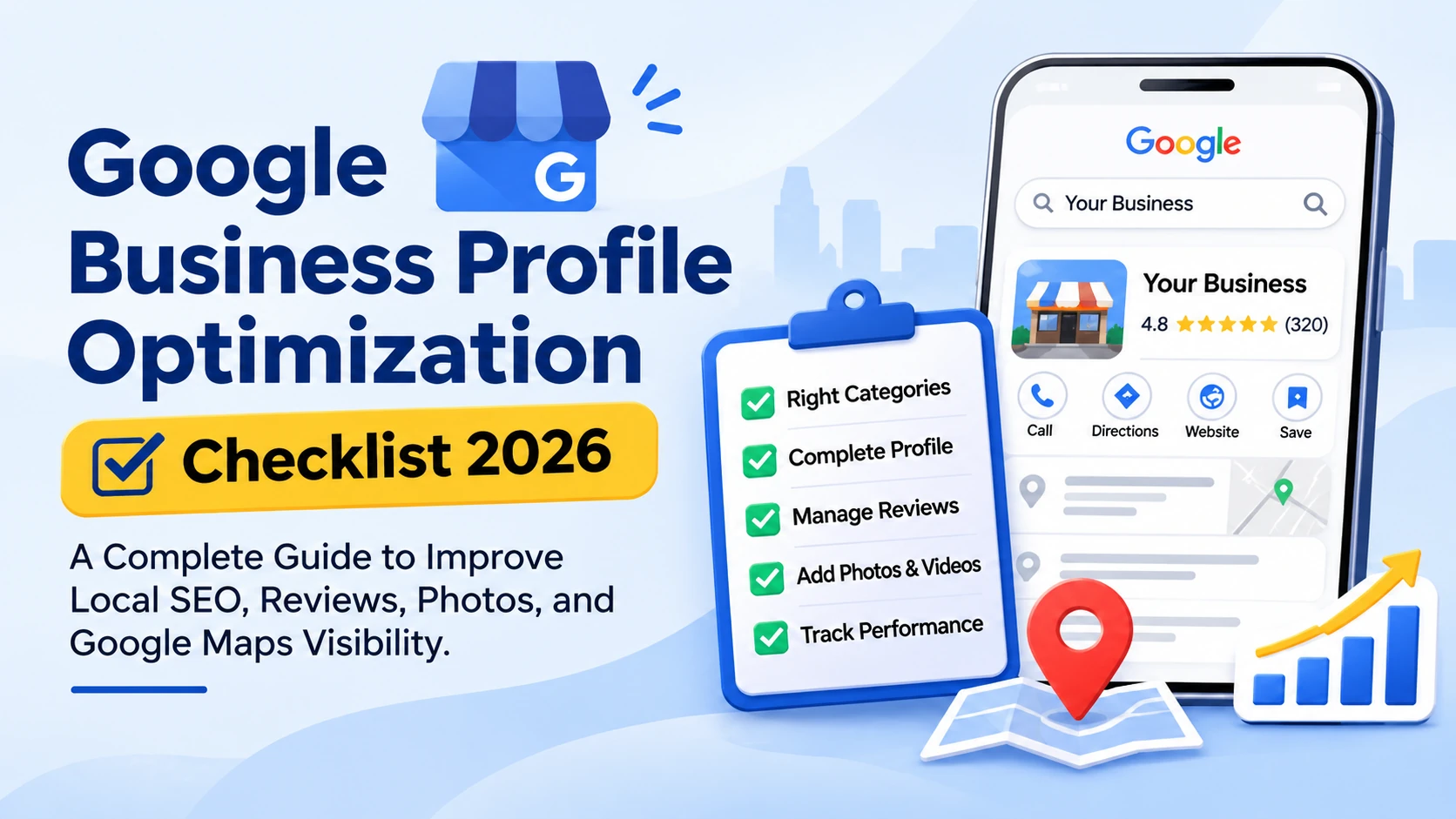
Google Business Profile Optimization Checklist 2026
Google Business Profile Optimization Checklist 2026
Every year, Golden Beacon Media prepares a checklist for its clients, which is used in Noida and Delhi NCR, and 2026 was a year that required extra updates. Nevertheless, the main parameters did not change. The information is divided into categories, and it contains information about the business itself and the existence of real photographs and reviews. What changed is the number of people reading the gathered information.
At the end of 2025, the public Q&A section ceased to exist, and Ask Maps replaced it. The assistant speaks to customers immediately, takes information from the profile, and reviews the website of the company. The assistant was available for Indian clients in March 2026; English was used at this time. Later, in August, Hindi was added. Thus, we see that a profile for a regular person and a profile for the assistant have some similarities, but the requirements differ and need to be followed exactly in the indicated order, which is the essence of the presented checklist.
Why Google Business Profile Optimization Alone Is Not Enough
Many items in this checklist are things that an owner can do themselves on a quiet Saturday. For example, they need to figure out the categories, the hours of operation, the pin placement, and the reviews. Things become more difficult further down the list because the owner needs to write the descriptions according to Google's rules and devise a review process that works even when the company is busy.
However, a perfectly designed profile is really just part of the whole picture because a search nowadays takes place on the search results page, Maps, AI Overviews, AI Mode, and through assistants like Ask Maps. Having a good profile does not mean your business will be found easily if your website does not live up to certain standards, contact information is not consistently mentioned throughout the web, or the company has an inactive social media presence.
How Golden Beacon Media Can Help
Golden Beacon Media is a full-service SEO and digital marketing agency, not a business that only touches a Google listing. The team works across the areas a business actually needs to show up consistently in modern search, including SEO and technical SEO, AI SEO covering both answer engine optimization (AEO) and generative engine optimization (GEO), content and search visibility strategy, social media marketing, paid marketing and performance campaigns, and website and mobile app development.
Such assistance is particularly helpful when the company has issues to solve at once, for example, when a profile looks good, but the website runs too slowly, or the local rankings fail to gain traction despite decent reviews and photographs. If you feel that you are unable to address at least one of these issues right now, it’s time to reach a team that can provide comprehensive assistance rather than just help with the profile.
Choosing the Right Categories
Every profile gets one primary category and can add up to nine secondary ones, and the two do different jobs, with the primary category serving as the single best answer to Google's own test question, "this business is a...". A nail salon should pick "Nail salon," not the wider "Salon," because the specific option tends to perform better, and Whitespark's 2026 The Local Search Ranking Factors survey, which pools scores from working local SEO practitioners, rates primary category selection as the single strongest factor for local pack and Maps visibility this year, ahead of every other signal it measures.
Unlike primary categories, secondary categories are more like departments. For example, the bakery with a small café can use "café" as the secondary category and keep "bakery" as the primary one. Make sure to add only the real associations. This means don’t think about making the list longer, because if you put in the wrong secondary category, you can invite the wrong customers to the bakery. Make category changes very rarely, because Google may require re-verification and remove the profile from the Internet for a certain period of time.
Completing Your Google Business Profile
The survey conducted by Whitespark also considers profile completeness as an important parameter. The official social media pages where every field is filled out perform much better than those with scanty details. Four matters are mainly important and should be dealt with in detail instead of trying to make them right in a hurry.
NAP Accuracy (Name, Address, Phone)
Proper NAP stands for name, address, and phone number, and all of them should match on the Google My Business profile, signboard, and website accordingly. It has been emphasized that only the legitimate business name can be included; therefore, it should not include terms like taglines, area names, or service keywords. Including such rules may lead to profile suspension. It’s important to put the business legal address from official papers and the plot number first, and provide landmarks only in case it’s not sufficient to find the location. Use the phone number of the business only, and not the phone number of an employee, in case the phone number range is not sufficient to locate the business.
Business Hours and Map Pin Placement
Hours now decide whether a business shows up for a search at all, since Whitespark's survey placed "open now" among the five strongest ranking signals for 2026. List the hours as they really are, and add special hours for Diwali, Holi, and any other day the business runs differently. Users of Google Maps are now able to propose a correction by taking a photo of the hours on the window, thus creating matching information for the listing and the online profile. After entering the page where edits are made, use the zoom option and move the pin to the correct location, which should be as close to the entrance of the business as possible.
Businesses that provide the service at the customer’s place are supposed to leave the street address out and use the actual radius, which is no more than two hours by road and does not include every area serviced by the company. For example, a repair company from Noida would be justified in marking Noida, Greater Noida, Ghaziabad, and East Delhi as places of work but would be wrong in putting the whole NCR in the listing.
Writing an Effective 750-Character Business Description
Google limits this slot to 750 characters, where it appears in the “About this Business” section, which makes it important to make it explicitly clear what it does, who it targets, in which region it does operates (operates ), and how long it has been functioning, as the first sentence is given higher importance than the rest of the paragraph. Essentially, pricing, limited-time offers, call-to-actions, and links are prohibited, which means that a sentence with “Call now for a holiday discount!" breaks two rules at once!
Additionally, this section is responsible for the majority of those AI visibility workings, so it is expected that someone does this properly and does not treat it as a different issue. AEO and GEO have to do with the clarity of facts for the AI.
For a local business, almost all of that groundwork happens right here in the profile. Speaking at Search Central Live Milan in June 2026, Google reiterated that optimizing for AI search is still SEO, built on the same accurate, consistent location data, hours, and services that have always mattered for local results. According to SOCi's 2026 Local Discovery Index, 52 percent of US consumers surveyed in 2026 had used an AI tool to find a local business in the past month, up from just 9 percent a year earlier. In India, a question put to Ask Maps might be something like "Which chartered accountant near Sector 62 handles GST returns and opens on Saturday? The response derives from a straightforward factual sentence similar to those that one encounters within the field, derived from the domain and attributes as well as reviews.
It's better to come up with a description on your own than to use AI tools because the experts in local search have recently started to consider AI-created text as a potential risk factor. The old question-and-answer section is now gone, which means a piece of information that could be found by clients before has to be placed somewhere accessible to Google. Provide the same information on the website with some short pages about each service provided along with a short list of crucial data like parking, payment methods, and the languages spoken. Google itself claims there’s no need to create any additional AI files or markups for this. Nevertheless, many people who utilized the LocalBusiness scheme say they have noticed some changes in the description of their companies compiled by AI, even though it didn’t affect their position in the search. Thus, this information should be considered general and not accurate. Make sure to check the "Collected info" tab now and then.
Assistants working outside the Google ecosystem rarely check the profile themselves, relying instead heavily on the website, directory, social page, and reviews, so the same name, address, phone number, and operating hours should be consistent throughout these sources. It would also be prudent to test this on a monthly basis by asking some actual customer questions in Ask Maps and AI mode, since the answers may vary considerably between inquiries.
Services and Attributes
To begin, "Edit services" and following Google's own suggestions for the category before proceeding to customize should be considered, as pre-defined services gained importance in this year's ranking, and Google would eventually show a competitor's service if the service fits what the client inquires for. Attributes should complement services, as they refer to factual details in the profile, such as wheelchair access, parking, online booking, and women-led businesses. Each attribute needs to be selected or excluded from the checklist based on whether it applies. This is exactly the information used by the assistant when responding to the inquiry, such as "which clinic nearby Sector 50 has parking?"
It is worth revisiting the Contact tab while in there too. Since August 2023, Google has let businesses add their own social media links directly to a profile, rather than relying on the links Google guessed at automatically before that change. Keeping Instagram, Facebook, or LinkedIn links current here gives both searchers and AI assistants one more consistent, verifiable data point to draw on.
Optimizing the Photo Gallery
The gallery needs to be filled up with real and actual photos of the workspace and the work itself, starting with the correct logo and cover photo rather than some standard placeholder. According to Google’s Recommendation, there should be at least three photos of the outside parts of the business, the interior, and the working process of the business because those are the images people are interested in.
The correct format of photos is JPG or PNG. The size must be at least 720 by 720 pixels and not heavier than five megabytes for each file. The videos can be 30 seconds long, and it is always nice to add subtitles to your video, as without them the video is played with sound turned off. Stock pictures and any pictures made by image creators can be avoided, as it is reported that local search specialists can now consider AI photos a serious risk.
Google Reviews Management
Reviews rank second only to the profile's own information among local ranking signals, and Google's AI summaries of a business lean heavily on review text when they are written.
How and When to Request Reviews
Each customer must be asked at some point immediately after the completion of a job or the meeting in order to ask for the feedback while the experience they’ve had is fresh in their memory. In the profile, “Read reviews” needs to be opened and then “Get more reviews” so that a link is created, or alternatively, a QR code could be downloaded while using a desktop browser for invoices and the billing counter. Google prohibits any kind of discounts, gifts, cashback, or rewards for writing a review, as well as asking only those customers who have a positive experience when using the business services. Moreover, according to the new rules, the business is not allowed to set target numbers of reviews for its employees or to inform them about the structure of reviews. Reviewers have also been able to post under a nickname since late 2025, so an unfamiliar name on a review is no longer unusual, and it is worth judging each one on what it actually says.
Responding to Positive and Negative Reviews
When possible, respond to reviews within a 48-hour timeframe with the company's own response, being specific about the service provided rather than delivering a vague thank-you. For a negative review, address the actual issue, explain in what ways the company has changed, and deal with intricate details either in the phone conversation or rather than in a public reply. Never mention anything medical or order numbers in public replies, as customers have the opportunity to report inappropriate responses to a review. Owners can also connect a profile to Gemini for drafted replies. Every draft still needs a proper read before it goes out under the business's name.
Building a Consistent Review Strategy
It is better to receive constant circulation of some reviews weekly than to collect a huge number of reviews in a short time. Google will suspend new reviews whenever it spots a weird increase in reviews, meaning that receiving too many reviews at once can backfire. Each person must know he is responsible for acquiring the reviews. The request can also be included in the process of billing or handover so that one does not have to memorize it. In severe cases of review spamming, Google can delete reviews, prevent new reviews from appearing for a while, hide old reviews, and issue a public warning.
Google Business Profile Performance Tracking
All of this shows up in the "Performance" tab, reached by searching the business name on Google while signed in as the owner or a manager.
Tracking Views, Calls, Clicks, and Customer Actions
Views reflect the total number of unique individuals who have checked out the profile on either Search or Maps, irrespective of whether they have viewed it multiple times. Search terms reveal what has been typed in by the user when searching for the profile. Google updates the search terms at the beginning of each month. Calls track only those clicks made on the button in the profile; thus, anyone calling a number from an external source will not be registered as a call. The submissions then show users’ direction requests, clicks on the site, text messages, and reservations.
Since June 2026, a profile can be linked to Google Analytics under "Admin" and then "Product links," which places these numbers next to the website's own data, though Analytics only keeps six months of profile history at a time. Search Console has also started showing a generative AI report to a subset of sites, covering impressions from AI Overviews and AI Mode specifically.
Setting Up a Monthly Maintenance Routine
Choose one day every month and allocate around an hour to that. After picking the dates, examine the emails from Google that suggest an edit. There is a four-day period allowed for accepting or rejecting the edits before Google goes ahead and publishes them. Add a few recent pictures and schedule monthly posts**. Posts older than six months quietly move into an archive** unless a date range has been set on them. Stale ones are worth clearing out too. Finish by answering any pending reviews and logging that month's figures against the same month a year earlier, which is usually a more useful comparison than last month alone.
How to Improve Google Maps Visibility
When it comes to optimizing a listing, it is all about how to make the company more certain and recognized by Google. This is reasonable, as distance, the third aspect in local ranking, cannot be modified in any way. It is not possible to pay for a better local ranking, nor can it be requested either.
Key Local Ranking Factors
Local search results from Google are determined based on three factors, which are relevance, distance, and prominence. Relevance refers to how relevant the business in question is to the search query, while prominence refers to how well-known the business is, which is evaluated based on its ratings or reviews, as well as how many other sites are linking to it. Whitespark's survey adds a few details that Google itself does not mention. A visible address tends to outrank a hidden one. Reviews with written text and recent dates sit higher than a bare star rating. On the website side, a separate page for each service tends to beat one page trying to cover everything.
Staying Consistent
Consistent weekly efforts will have greater impact than performing one huge deep clean each year, so you should just share a post, upload several photos, and take enough time to ensure that all information is still relevant. Such a pattern is the basis of many paid Google My Business optimization services, which means that a business owner with an active calendar reminder can do most activities on his/her own.
Common Mistakes to Avoid
The costliest mistake in Whitespark's survey was a website link that redirects to a completely different domain, which happens more often than it should after a site migration. Next came service areas stretched far beyond what a business can realistically travel to. Duplicate profiles for a single location split reviews between two listings instead of building one strong one, and a virtual office or a rented mailbox does not count as a real address under Google's rules. Keep primary ownership inside a Google account the business itself controls, and if outside help is brought in for local SEO or a website rebuild, add that team as a manager on the account rather than sharing the password directly.
Start this week with the category and the NAP details, since those two decisions shape everything that follows. Put the monthly check into a calendar before it slips.
FAQs About Google Business Profile Optimization
1. Is a Google Business Profile free to use?
Creating and managing a Google Business Profile costs nothing. The only charges come from running ads on top of it.
2. Is Google My Business the same as Google Business Profile?
Yes, Google renamed Google My Business to Google Business Profile back in November 2021. Plenty of people still use the old name out of habit, which is why "Google My Business optimization" remains a common search phrase.
3. How does Google verify a business in 2026?
Google chooses the verification method itself, usually a short video, a code sent by phone or email, a live video call, or a postcard. The review can take up to five business days to complete.
4. How long does it take to see results on Google Maps?
Most profile edits appear within a few days once Google reviews them. Actual ranking gains depend heavily on local competition and usually build up gradually over several weeks.
5. Do Google posts help a Maps ranking?
Google has never confirmed any direct ranking effect from posts, and specialists generally treat them as a minor signal at best. Their real value is showing customers that a business is still active.
6. Can two businesses share one address?
Yes, as long as each is a genuinely separate business with its own signage and its own staff on site. A shared desk in a co-working space with no signage or dedicated staff does not qualify.
7. What should a business do if Google suspends its profile?
Fix whatever actually broke the guidelines first, such as a keyword stuffed into the business name. Then appeal through Google's own appeals tool with proof like a GST certificate or a recent utility bill.
8. Can one account manage several locations?
Yes, each location gets its own profile sitting under one shared account. Businesses with ten or more locations can ask Google for bulk verification instead of doing each one by hand.
9. What does a good Google My Business optimization service actually include?
A solid one covers a full profile audit, correcting any wrong details, a proper review request process, and a monthly report. Better ones in 2026 also check how AI assistants describe the business when asked.
10. Which agency handles this kind of work in Noida?
Golden Beacon Media is a Noida-based, full-service SEO and digital marketing agency at 5th Floor, Anthurium, No. 3, 518, Sector 73, Noida, Uttar Pradesh 201316, with 37 Google reviews at the time of writing. Call +91 98737 74066, or get in touch to talk through SEO, AI search visibility, paid campaigns, or a wider digital marketing strategy - not just a Google Business Profile audit.
Recent Blogs

Search Engine Optimization Services USA

Best Digital Marketing Agency India for Sustainable Brand Growth

Best Ecommerce SEO Agency in India for Online Growth